
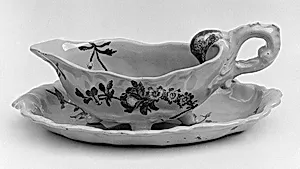
Sauceboat and tray
ca. 1760
Medium
Faience (tin-glazed earthenware)
Dimensions
Overall (sauceboat .66): 2 3/4 × 9 1/4 in. (7 × 23.5 cm); Overall (tray .67): 4 1/8 × 10 in. (10.5 × 25.4 cm)
Classification
Ceramics-Pottery
Culture
French, Marseilles
Department
European Sculpture and Decorative Arts
Museum
Metropolitan Museum of Art, New York, NY
Credit
Gift of R. Thornton Wilson, in memory of Florence Ellsworth Wilson, 1950
Accession Number
50.211.66, .67
Rights
Public Domain
Art Historical Context
This elegant sauceboat and matching tray, crafted around 1760 by the Ve Perrin Factory in Marseilles France, exemplify the refined artistry of 18th-century European ceramics. Made of faience—tin-glazed earthenware—the set measures a compact 2¾ × 9¼ inches for the sauceboat and ⅛ × 10 inches for the tray, perfect for intimate dining tables. The factory, led by the widow (veuve) Perrin, was a powerhouse in Marseilles' thriving pottery industry, producing luxurious tableware that rivaled pricier porcelain imports from Asia. Faience's tin glaze created a smooth, white surface ideal for vibrant painted decorations, a technique perfected in southern France during the Rococo era. Marseilles faience makers like Veuve Perrin drew inspiration from Chinese and Meissen porcelain, blending exotic motifs with local flair to appeal to affluent households. These pieces highlight the era's obsession with opulent dining, where functional objects doubled as status symbols. Generously gifted to The Metropolitan Museum of Art in 1950 by R. Thornton Wilson in memory of Florence Ellsworth Wilson, this set offers a glimpse into Enlightenment-era craftsmanship, showcasing how everyday luxury elevated French culinary culture.