
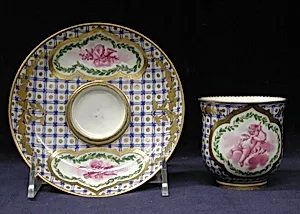
Saucer
Unknown Artist
18th–19th century
Medium
Soft-paste porcelain
Dimensions
Diameter: 5 1/16 in. (12.9 cm)
Classification
Ceramics-Porcelain
Culture
French
Department
European Sculpture and Decorative Arts
Museum
Metropolitan Museum of Art, New York, NY
Credit
Gift of Irwin Untermyer, 1964
Accession Number
64.101.373
Rights
Public Domain
Tags
Art Historical Context
This delicate saucer, crafted in soft-paste porcelain by an unknown French artist during the 18th or 19th century, the elegance of European decorative arts. Measuring just 5 1/16 inches (12.9 cm) in, it features motifs of bows and arrows intertwined with floral elements, rendered in a refined style typical of the period's Rococo or Neoclassical influences. Soft-paste porcelain, a European innovation blending clay, glass frit, and other materials fired at lower temperatures than true hard-paste, allowed for intricate molding and vibrant overglaze enameling—techniques that made French ceramics prized worldwide. Historically, such pieces were produced at renowned manufactories like Sèvres or Vincennes, reflecting France's rivalry with Chinese porcelain imports and the opulence of aristocratic dining. The bow-and-arrow motif may evoke Cupid's symbols of love, paired with flowers for a playful, romantic flair, underscoring the era's emphasis on whimsy in everyday luxury objects. Donated to the Metropolitan Museum of Art in 1964 by Irwin Untermyer, this saucer highlights the accessibility of high craftsmanship, inviting us to appreciate the fusion of utility and artistry in 18th–19th-century France.