
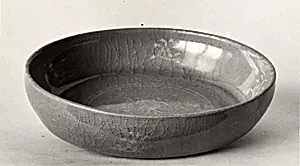
Saucer
Unknown Artist
ca. 1150
Medium
Porcelaneous clay
Dimensions
H. 1 1/8 in. (2.9 cm); Diam. 4 1/2 in. (11.4 cm)
Classification
Ceramics
Culture & Period
Korea · Goryeo dynasty (918–1392)
Department
Asian Art
Museum
Metropolitan Museum of Art, New York, NY
Credit
Gift of R. H. Macy & Co., 1919
Accession Number
19.39.5
Rights
Public Domain
Art Historical Context
This delicate saucer, crafted around 1150 during Korea's Goryeo dynasty918–1392), the era's mastery of ceramics. Produced by an unknown artisan, it hails from a period when Korean potters achieved remarkable technical sophistication, rivaling contemporary Chinese wares. Measuring just 1 1/8 inches high and 4 1/2 inches in diameter, this petite vessel was likely used for serving tea, sauces, or small delicacies in elite households, reflecting the refined aesthetics of Goryeo court life. Made from porcelaneous clay—a high-fired stoneware body prized for its smooth, ivory-like surface and subtle translucency—this saucer represents an early step toward true porcelain. Goryeo potters fired such clays at intense temperatures in dragon kilns, producing durable yet elegant pieces that symbolized cultural prestige. Often adorned with celadon glazes (though not specified here), these ceramics were exported widely, influencing East Asian traditions. Today, housed in the Metropolitan Museum of Art's Asian Art Department as a 1919 gift from R. H. Macy & Co., this saucer invites us to appreciate Goryeo's blend of innovation and subtlety—a quiet testament to Korea's enduring ceramic legacy.