
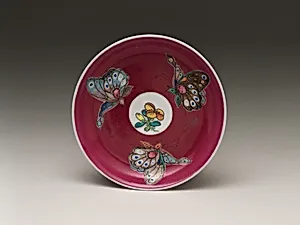
Saucer with Butterflies
Unknown Artist
18th century
Medium
Porcelain painted with colored enamels and gilded (Jingdezhen ware)
Dimensions
Diam. 4 5/8 in. (11.7 cm)
Classification
Ceramics
Culture & Period
China · Qing dynasty (1644–1911), Qianlong period (1736–95)
Department
Asian Art
Museum
Metropolitan Museum of Art, New York, NY
Credit
Purchase by subscription, 1879
Accession Number
79.2.634
Rights
Public Domain
Tags
Art Historical Context
This delicate saucer, crafted in the renowned porcelain workshops of Jingdezhen during China’s Qing dynasty, exemplifies the refined taste of the Qianlong (1736–95). Produced in the 18th century, the small porcelain piece measures just over four and a half inches across and was decorated with colored enamels and gilding, techniques that highlight the extraordinary skill of Jingdezhen artisans. These imperial kilns supplied both the court and an eager international market with wares prized for their luminous surfaces and intricate designs. The saucer’s central motif of butterflies, rendered in vibrant enamels against a gilded ground, carries layers of cultural resonance. In Chinese tradition, butterflies often symbolize joy, transformation, and marital happiness, making such objects popular as gifts or personal treasures. The careful application of overglaze enamels allowed painters to achieve subtle gradations of color, while the gilding added a touch of opulence suited to elite households. Acquired by the Metropolitan Museum of Art in 1879 through public subscription, this Jingdezhen saucer offers visitors a glimpse into the sophisticated ceramic traditions that flourished under imperial patronage. Its modest size belies the technical mastery and cultural significance embodied in every detail.