
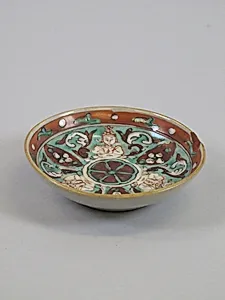
Saucer with Thai mythical figures
Unknown Artist
19th century
Medium
Porcelain painted in overglaze polychrome enamels (Bencharong ware for Thai market)
Dimensions
Diam. 4 5/8 in. (11.7 cm)
Classification
Ceramics
Culture & Period
China · Qing dynasty (1644–1911)
Department
Asian Art
Museum
Metropolitan Museum of Art, New York, NY
Credit
Avery Fund, 1909
Accession Number
09.70.29
Rights
Public Domain
Art Historical Context
This delicate saucer, measuring just 4 5/8 inches in diameter, exemplifies Bencharong ware—a rare type of Chinese porcelain crafted during the Qing dynasty (16441911) specifically for elite Thai market. Produced in 19th-century Jingdezhen kilns, it features vibrant overglaze polychrome enamels, a technique where colorful pigments are fired onto the glazed surface at low temperatures, allowing for intricate, jewel-like designs that wouldn't survive higher kiln heats. The saucer's surface bursts with Thai mythical figures, likely including garuda, yaksha, or other legendary beings from Siamese folklore, blending Chinese technical mastery with Thai cultural motifs. Bencharong, meaning "five colors" in Thai, was a luxury export good commissioned by Thai royalty and nobility, often used in temple rituals or elite dining sets. These pieces highlight the vibrant trade networks between Qing China and Siam (modern Thailand), where Chinese potters adapted their artistry to local tastes, incorporating Buddhist and animist iconography. Acquired by the Metropolitan Museum of Art through the Avery Fund in 1909, this saucer offers a window into cross-cultural exchange, showcasing how porcelain became a canvas for storytelling across Asia. Though the artist remains unknown, the saucer's vivid enamels and compact form make it a captivating example of how everyday objects carried profound cultural weight in 19th-century Asia.