
Saul
1899
Medium
oil on canvas
Dimensions
0; 60; 3; 80
Rights
Public Domain
About this artwork
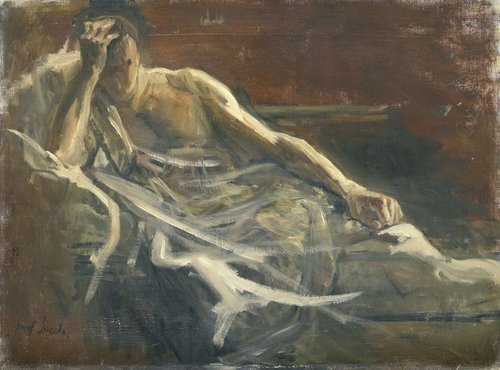
Saul liggend op een bank, met de rechterhand op het voorhoofd. Uit een reeks van vijf studies voor een schilderij van Saul en David uit 1899 (zie ook SK-A-3731, SK-A-4180, SK- A-4198 en SK-A-3732).
Art Historical Context
In the hushed galleries of the Rijksmuseum, Jozef Israëls' *Saul* (1899) offers a poignant glimpse into the artist's late-career exploration of biblical narratives. Israëls, a leading figure of the Dutch Hague School, was renowned for his realistic depictions of everyday life infused with emotional depth and subtle atmospheric effects. By the 1890s, he turned to grand historical and religious subjects, drawing from the Old Testament story of King Saul, tormented by melancholy and divine disfavor, as recounted in 1 Samuel. This oil on canvas study (60 × 80 cm) captures Saul in a moment of profound introspection: reclining on a bench with his right hand pressed to his forehead, evoking inner turmoil. As one of five preparatory sketches for Israëls' larger *Saul and David* (also 1899), it reveals the meticulous process behind his compositions—related works (SK-A-3731, SK-A-4180, SK-A-4198, SK-A-3732) explore poses and lighting to build narrative tension, anticipating David's soothing harp-playing. The intimate scale and rich impasto of the oil medium highlight Israëls' mastery of light and shadow, lending psychological weight to Saul's solitude. This study not only showcases his evolution toward more dramatic humanism but also underscores the enduring cultural resonance of biblical themes in 19th-century Dutch art, inviting visitors to ponder the universal pangs of the human spirit.
About the Artist
Jozef Israëls · 1824–1911
Israëls was born in Groningen to poor Jewish parents. He trained as an artist in Groningen and Amsterdam, and between 1845 and 1855, he expanded his training by travelling to Paris, Dusseldorf, and the artist's colony at Oosterbeek. However, the most influential locations he visited were the Dutch seaside towns of Zandvoort and Katwijk, were he adopted genre painting as a means of documenting the ...