
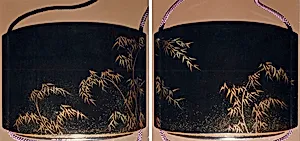
笹鶏蒔絵鞘印籠 銘「古満貞榮」|Saya Inrō with Bamboo Grove (exterior) and Rooster with Hen (interior)
second half of the 18th century
Medium
Sheath shape; lacquered wood with gold and silver togidashimaki-e on black lacquer ground Netsuke: sage lashing his back with a fly whisk; wood with coral and ivory inlay Ojime: bronze bead with metal inlay of flowers
Dimensions
2 7/16 x 2 15/16 x 15/16 in. (6.2 x 7.5 x 2.4 cm)
Classification
Inrō
Culture & Period
Japan · Edo period (1615–1868)
Department
Asian Art
Museum
Metropolitan Museum of Art, New York, NY
Credit
Gift of Wilton Lloyd-Smith and his wife, Marjorie Fleming Lloyd-Smith, 1929
Accession Number
29.82.10
Rights
Public Domain
Tags
Art Historical Context
This exquisite *Saya Inrō* by Koma Sadahide, crafted in the second half of the th century during Japan's Edo period (1615–1868), exemplifies the pinnacle of lacquer artistry. An *inrō* was a portable lacquered case worn suspended from a kimono sash via a silk cord, used by gentlemen to carry medicines, seals, or tobacco. Sadahide, a master lacquerer, signed the piece "Koma Sadahide" (古満貞榮), adorning its sheath-shaped black lacquer ground with intricate *togidashimaki-e*—a technique layering gold and silver powders beneath clear lacquer, then burnishing to reveal shimmering designs. The exterior depicts a lush bamboo grove, symbolizing resilience and prosperity in Japanese culture, while the interior reveals a rooster courting a hen, evoking themes of vitality and good fortune—roosters being auspicious omens of the dawn. Complementing the *inrō* are a wooden netsuke of a sage playfully lashing his back with a fly whisk (inlaid with coral and ivory for vivid detail) and a bronze *ojime* bead etched with floral motifs, securing the cord. As a functional yet opulent accessory, this piece from the Metropolitan Museum of Art's Asian Art collection highlights Edo-era craftsmanship, where lacquerware blended utility with poetic nature motifs, serving as a subtle status symbol for the elite. Gifted in 1929, it invites us to appreciate Japan's enduring fusion of art and everyday elegance.