
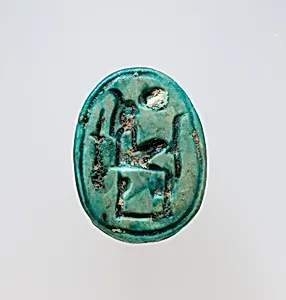
Scarab
Unknown Artist
ca. 1479–1458 B.C.
Medium
Faience
Dimensions
L. 1.5 cm (9/16 in.)
Classification
Scarab
Period
New Kingdom
Department
Egyptian Art
Museum
Metropolitan Museum of Art, New York, NY
Credit
Rogers Fund, 1923
Accession Number
23.3.183
Rights
Public Domain
Tags
Art Historical Context
This exquisite scarab, crafted around 1479–1458 B.C. during Egypt's New Kingdom (Dynasty 18), exemplifies the era's mastery of faience—a vibrant, glazed ceramic made from crushed quartz and fired to a brilliant blue-green sheen. Measuring just 1.5 cm long, this diminutive amulet was produced using intricate molding and glazing techniques, allowing for fine details on its beetle form despite its small scale. Faience's durability and luminous quality made it ideal for everyday sacred objects, bridging the divine and the domestic in ancient Egyptian life. Scarabs like this one symbolized rebirth and transformation, embodying the sun god Khepri, who pushed the sun across the sky much like a dung beetle rolls its ball. Worn as jewelry, used as seals for documents, or placed in tombs, they carried protective magic and royal authority. Dynasty 18, a golden age of pharaohs like Hatshepsut and Thutmose III, saw scarabs proliferate as emblems of prosperity and eternity. Acquired through the Rogers Fund in 1923 and now housed in the Metropolitan Museum of Art's Egyptian Art collection, this anonymous masterpiece invites us to ponder the profound spirituality encoded in such a tiny form—a testament to Egypt's enduring artistic legacy.