
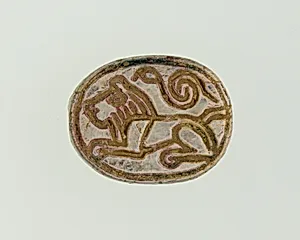
Scarab Base with Incised Lion and Cobra
Unknown Artist
664–525 B.C.
Medium
Green glazed steatite
Dimensions
L. 1.5 × W. 1.2 × H. 0.4 cm (9/16 × 1/2 × 3/16 in.)
Classification
Scarab, lion, uraeus, spiral
Period
Late Period
Department
Egyptian Art
Museum
Metropolitan Museum of Art, New York, NY
Credit
Rogers Fund, 1926
Accession Number
26.3.121
Rights
Public Domain
Tags
Art Historical Context
Behold the *Scarab Base with Inc Lion and Cobra*, autive treasure from ancient Egypt's Late Period (–525 B.C.), during Dynasty 26. This tiny artifact, measuring just 1.5 × 1.2 × 0.4 cm, is fashioned from green glazed steatite—a soft stone coated in vibrant glaze to mimic precious materials like turquoise or lapis lazuli. Shaped as the sacred scarab beetle, a symbol of the sun god Khepri and rebirth, its base features finely incised images of a powerful lion and a rearing cobra, executed with remarkable precision for such a small scale. In the Saite Period (Dynasty 26), Egyptian artisans revived archaic styles, producing scarabs as amulets, seals, and jewelry components to invoke protection and renewal. The lion evokes strength and royal ferocity, possibly alluding to protective deities like Sekhmet, while the cobra—likely a uraeus—represents the fiery guardian of pharaohs, warding off enemies. Worn or used in daily life, these objects blended utility with profound symbolism, bridging the mundane and divine. Acquired through the Rogers Fund in 1926, this piece at the Metropolitan Museum of Art exemplifies the exquisite micro-carving techniques of Egyptian lapidaries, where every incision held magical potency. A window into a world where even the smallest talisman carried the weight of eternity.