
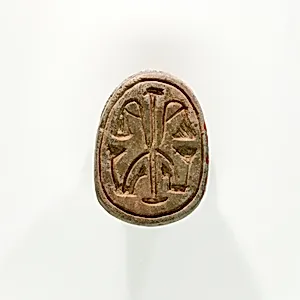
Scarab from Rennefer's Burial
Unknown Artist
ca. 1504–1447 B.C.
Medium
Faience
Dimensions
L. 1.6 cm (5/8 in.); W. 1.2 cm (1/2 in.); H. 0.8 cm (5/16 in.)
Classification
Scarab, union of two lands, Rennefer
Period
New Kingdom
Department
Egyptian Art
Museum
Metropolitan Museum of Art, New York, NY
Credit
Rogers Fund, 1935
Accession Number
35.3.82
Rights
Public Domain
Tags
Art Historical Context
Nestled in the treasures of the Metropolitan Museum of Art's Egyptian Art collection, the *Scarab from Rennefer's Burial* is a diminutive yet profound artifact from Egypt's New Kingdom, early Dynasty 18 (ca. 1504–1447 B.C.). Measuring a mere 1.6 cm long, 1.2 cm wide, and 0.8 cm high, this faience amulet—acquired through the Rogers Fund in 1935—was discovered in the tomb of Rennefer, likely serving as a protective charm for his journey into the afterlife. In ancient Egyptian culture, scarabs embodied the sacred dung beetle, symbolizing rebirth, transformation, and the sun god's eternal cycle. These beetles were revered as potent talismans, often worn as jewelry or used as seals, bridging the living world and eternity. Crafted from faience—a glazed, quartz-based ceramic prized for its affordable brilliance and vivid turquoise hues—this scarab showcases the era's masterful molding and glazing techniques, mimicking costlier stones like lapis lazuli. From the dawn of the New Kingdom, a pinnacle of Egyptian power under rulers like Thutmose I, such objects highlight everyday spirituality amid monumental achievements. Though by an unknown artist, its survival whispers of Rennefer's hopes for immortality, inviting us to ponder the enduring magic of these tiny guardians.