
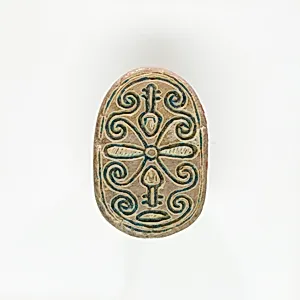
Scarab from Ruiu's Burial
Unknown Artist
ca. 1504–1447 B.C.
Medium
Steatite (glazed)
Dimensions
L. 2.2 cm (7/8 in.); W. 1.5 cm (9/16 in.); H. 0.9 cm (3/8 in.)
Classification
Scarab, Ruiu, scroll, nefer
Period
New Kingdom
Department
Egyptian Art
Museum
Metropolitan Museum of Art, New York, NY
Credit
Rogers Fund, 1935
Accession Number
35.3.48
Rights
Public Domain
Tags
Art Historical Context
This exquisite scarab amulet, unearthed from the burial of Ruiu during the early New Kingdom's Dynasty 18 (ca. 1504–1447 B.C.), ancient Egyptian artistry in miniature form. Measuring just 2.2 cm long, it served as a protective talisman, likely placed among the deceased's grave goods to invoke rebirth and divine favor. Scarabs, modeled after the sacred dung beetle Khepri—who symbolized the sun's daily renewal—were ubiquitous in funerary contexts, blending spirituality with everyday symbolism. Crafted from steatite, a soft soapstone, and glazed to a vibrant blue-green sheen, the scarab showcases masterful Egyptian lapidary techniques. Artisans carved intricate hieroglyphs into its base, possibly bearing Ruiu's name or protective spells, while the beetle's naturalistic form was incised with precision using fine tools. This glazing mimicked precious stones like lapis lazuli, elevating even humble materials to sacred status. Housed in the Metropolitan Museum of Art's Egyptian Art Department (Rogers Fund, 1935), this artifact illuminates the era's beliefs in the afterlife during a golden age of pharaonic power. For visitors, it offers a tangible glimpse into personal devotion amid monumental pyramids and temples, reminding us of Egypt's enduring fascination with eternity.