
Scarab Inscribed with a Hieroglyphic Motif
Unknown Artist
ca. 1479–1458 B.C.
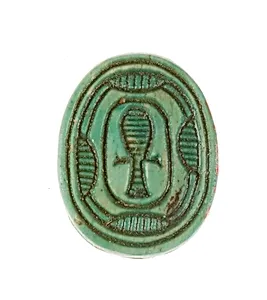
Medium
Steatite (glazed)
Dimensions
L. 1.4 cm (9/16 in); w. 1.1 cm (7/16 in); h. 0.6 cm (1/4 in)
Classification
Scarab; ankh; simple back
Period
New Kingdom
Department
Egyptian Art
Museum
Metropolitan Museum of Art, New York, NY
Credit
Rogers Fund, 1927
Accession Number
27.3.375
Rights
Public Domain
Tags
Art Historical Context
This petite scarab, carved from glazed steatite during Egypt's New Kingdom (ca. 1479–1458 B.C.), exemplifies the everyday artistry of Dynasty 18, an era of imperial expansion under pharaohs like Hatspsut and Thutm III. Measuring just 1.4 cm long, it was likely worn as an amulet or used as a seal, its compact form ideal for personal adornment or administrative stamps. The hieroglyphic motif inscribed on its flat base—typical of scarabs—probably invoked protective spells or royal names, blending practicality with profound symbolism. Steatite, a soft soapstone, was favored for scarabs due to its carvability, allowing skilled artisans to incise precise hieroglyphs before applying a vibrant glaze for durability and luster. This glazing technique mimicked the iridescent sheen of faience, elevating humble objects into talismans of rebirth, as the scarab beetle represented the sun god Khepri's daily renewal. Housed in the Metropolitan Museum of Art's Egyptian Art department (Rogers Fund, 1927), this artifact offers a window into ancient Egyptian life: a fusion of magic, bureaucracy, and beauty in the palm of one's hand. Such scarabs were ubiquitous, underscoring how spirituality permeated even the smallest possessions.