
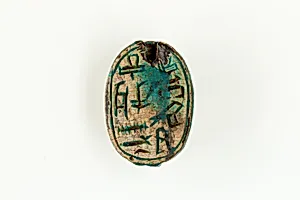
Scarab of an Official
Unknown Artist
ca. 1760–1640 B.C.
Medium
Blue glazed steatite
Dimensions
L. 2.3 × W. 1.6 × H. 1.1 cm (7/8 × 5/8 × 7/16 in.)
Classification
Scarab, official, private name and titles, Intef
Period
Middle Kingdom
Department
Egyptian Art
Museum
Metropolitan Museum of Art, New York, NY
Credit
Rogers Fund, 1915
Accession Number
15.3.21
Rights
Public Domain
Tags
Art Historical Context
This exquisite *Scarab of an Official*, around 1760–1640 B.C. during Egypt's Middle Kingdom (mid late Dynasty 13), a petite gem from the Metropolitan Museum of Art's Egyptian Art collection. Measuring just 2.3 × 1.6 × 1.1 cm, this blue glazed steatite amulet exemplifies the scarab form—a stylized dung beetle sacred to the ancient Egyptians as an emblem of rebirth and the rising sun god Khepri. Produced by an unknown artisan, it likely served as a personal seal or protective talisman for a high-ranking official, bearing hieroglyphs that would have inscribed the owner's name or titles. The medium of steatite, a soft soapstone, was ideal for intricate carving before glazing, a technique that fired the stone with a vibrant blue frit to mimic precious lapis lazuli. This affordable luxury made scarabs accessible beyond royalty, flooding Middle Kingdom society as jewelry, stamps, and charms. During Dynasty 13's political fragmentation, such objects underscored enduring administrative traditions and personal piety amid instability. Today, this Rogers Fund acquisition of 1915 offers a window into everyday elite life, reminding us how these tiny beetles carried cosmic weight in ancient Egyptian culture—symbols of transformation as enduring as the Nile's floods.