
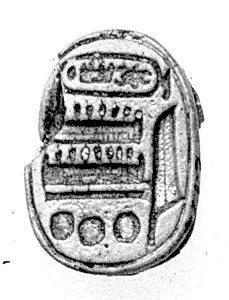
Scarab of Thutmose III
Unknown Artist
ca. 1479–1425 B.C.
Medium
Faience
Dimensions
l. 2 cm (13/16 in)
Classification
Scarab, Thutmose III
Period
New Kingdom
Department
Egyptian Art
Museum
Metropolitan Museum of Art, New York, NY
Credit
Purchase, Edward S. Harkness Gift, 1926
Accession Number
26.7.174
Rights
Public Domain
Tags
Art Historical Context
Behold the Scarab of Thutmose III, a diminutive yet mighty artifact from ancient Egypt's New Kingdom (. 1479–1425 B.C.), specifically Dynasty 18. Crafted during the reign of one of Egypt's greatest warrior-pharaohs, Thutmose III—who expanded the empire through brilliant military campaigns—this tiny faience scarab (just 2 cm long) as both a personal seal and a potent amulet. Housed in the Metropolitan Museum of Art's Egyptian Art department, it was acquired through the Edward S. Harkness Gift in 1926. Faience, a glazed ceramic composite of quartz, lime, and clay, was prized for its vibrant turquoise hue mimicking precious lapis lazuli, making fine jewelry accessible beyond the elite. The scarab's beetle shape evokes Khepri, the sun god symbolizing rebirth and transformation, while its incised hieroglyphs likely bear the pharaoh's royal names or titles, a common feature on such seals used to authenticate documents by rolling them across clay. These scarabs were cultural powerhouses: worn as jewelry, buried with the dead, or exchanged as diplomatic gifts, they embodied protection, eternity, and royal authority. This exquisite example invites us to marvel at the ingenuity of anonymous Egyptian artisans, whose miniature masterpieces encapsulated the grandeur of an empire at its zenith.