
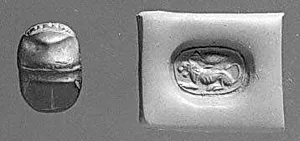
Scarab stamp seal
Unknown Artist
ca. 3rd century BCE
Medium
Steatite
Dimensions
0.31 x 0.51 in. (0.79 x 1.3 cm)
Classification
Stone-Stamp Seals
Culture & Period
Seleucid · Seleucid
Department
Ancient Near Eastern Art
Museum
Metropolitan Museum of Art, New York, NY
Credit
Rogers Fund, 1958
Accession Number
58.31.26
Rights
Public Domain
Tags
Art Historical Context
This exquisite scarab stamp seal, crafted from smooth steatite around the 3rd century BCE, hails from the Seleucid Empire—a kingdom that blended Greek and ancient Near Eastern traditions following Alexander the Great's conquest. Measuring just 0.31 x 0.51 inches, this tiny artifact exemplifies the intricate artistry of Seleucid stone carving, where soft steatite allowed for fine detailing on such a minuscule scale. Shaped like the sacred scarab beetle—originally an Egyptian symbol of rebirth and the sun god—the seal likely features lions, evoking power, royalty, and protection in Near Eastern iconography. Stamp seals like this were pressed into soft clay to create impressions for authenticating documents, goods, or magical amulets, serving both practical and ritual purposes in daily life and administration. Housed in the Metropolitan Museum of Art's Ancient Near Eastern Art department (Rogers Fund, 1958), this piece offers a window into Seleucid cultural fusion, where Eastern motifs met refined Hellenistic precision, highlighting the enduring legacy of stamp seals across millennia.