
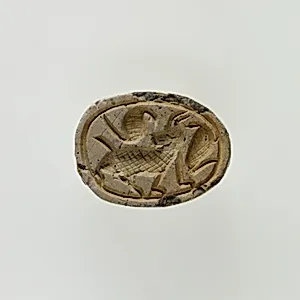
Scarab with Horned Animal and Uraei
Unknown Artist
ca. 1640–1500 B.C. (late Middle Bronze Age IIB-IIC)
Medium
Steatite
Dimensions
L. 2 × W. 1.4 × H. 0.8 cm (3/4 × 9/16 × 5/16 in.)
Classification
Scarab, animal, antelope, uraeus
Period
Second Intermediate Period
Department
Egyptian Art
Museum
Metropolitan Museum of Art, New York, NY
Credit
Rogers Fund and Edward S. Harkness Gift, 1922
Accession Number
22.1.329
Rights
Public Domain
Tags
Art Historical Context
This exquisite scarab, carved from steatite during Egypt’s Second Intermediate Period (ca. 1640–1500 B.C.), exemplifies the enduring popularity of beetle-shaped amulets in ancient Egyptian culture. Scarabs were modeled after the dung beetle, whose habit of rolling balls of earth evoked the sun’s daily journey and the promise of rebirth. Measuring just two centimeters in length, this tiny object would have been worn as jewelry, used as a seal, or placed with the deceased to ensure protection in the afterlife. The base features a horned animal flanked by uraei— rearing cobras that symbolized royal authority and divine guardianship. Such motifs combined protective and regenerative imagery, reflecting the complex beliefs of a time marked by political fragmentation yet rich artistic continuity. Steatite, a soft stone that hardens when fired, allowed artisans to achieve fine detail while making the piece durable for everyday or funerary use. Acquired by the Metropolitan Museum through the Rogers Fund and Edward S. Harkness Gift in 1922, this scarab offers visitors a tangible connection to the personal devotional practices of the Middle Bronze Age. Its compact form and symbolic decoration highlight how even the smallest artifacts carried profound cultural meaning across millennia.