
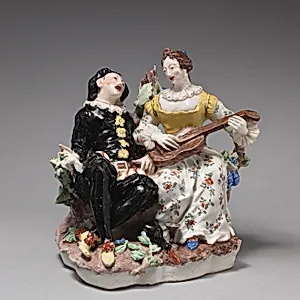
Scaramouche and Isabella
Medium
Soft-paste porcelain
Dimensions
Overall (confirmed): 7 × 6 13/16 × 6 in. (17.8 × 17.3 × 15.2 cm)
Classification
Ceramics-Porcelain
Culture
British, Bow, London
Department
European Sculpture and Decorative Arts
Museum
Metropolitan Museum of Art, New York, NY
Credit
Gift of Irwin Untermyer, 1964
Accession Number
64.101.689
Rights
Public Domain
Tags
Art Historical Context
**Scaramouche and Isabella** ca. 1748 Bow Porcelain Factory, after designs by Charles Nicolas Cochin I and Antoine Watteau Soft-paste porcelain The Metropolitan Museum of Art, New York Step into the whimsical world of 18th-century British porcelain with this charming figurine group from the Bow Porcelain Factory in London. Crafted around 1748, *Scaramouche and Isabella* captures two iconic characters from the Italian *commedia dell'arte* tradition—Scaramouche, the boastful swordsman-clown, and Isabella, the clever ingenue. Modeled in delicate soft-paste porcelain, a prized English innovation blending clay, glass frit, and soapstone for its creamy translucency, the 7-inch-tall ensemble likely depicts them in a lively theatrical pose, complete with musical instruments that evoke the playful performances popular across Europe. Produced at Bow, one of Britain's earliest porcelain factories (active 1744–1776), this piece reflects the Rococo spirit inspired by French masters Antoine Watteau—known for his elegant *fêtes galantes*—and engraver Charles Nicolas Cochin I. Watteau's influence brought graceful, animated figures to English tabletops, rivaling luxurious Meissen wares from Germany. These figurines were coveted status symbols for the elite, adorning Rococo interiors with scenes of music, romance, and comedy. Today, gifted to the Met in 1964, it highlights porcelain's technical leap in Britain and the enduring cultural allure of *commedia dell'arte*, blending artistry, theater, and innovation in a single, enchanting object. (218 words)
About the Artist
Bow Porcelain Factory|Charles Nicolas Cochin I|Antoine Watteau · 1747–1776
The Bow Porcelain Factory, established around 1747 in East London near Bow and relocated by 1749 to "New Canton" east of the River Lea, emerged as one of England's pioneering soft-paste porcelain manufacturers, rivaling the Chelsea factory. Founded by merchant Edward Heylyn and Irish painter Thomas Frye, who secured key patents in 1744 and 1748–49 for using Cherokee kaolin and bone ash, the factor...