
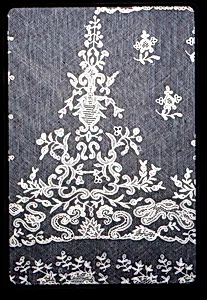
Scarf
Unknown Artist
19th century
Medium
Machine net
Dimensions
L. 102 x W. 21 inches 259.1 x 53.3 cm
Classification
Textiles-Laces
Culture
Irish, Limerick
Department
European Sculpture and Decorative Arts
Museum
Metropolitan Museum of Art, New York, NY
Credit
Gift of Georgiana Schuyler, 1900
Accession Number
00.1.10
Rights
Public Domain
Art Historical Context
This elegant 19th-century scarf from Limerick, Ireland, showcases the artistry of machine net lace, a hallmark of the region's renowned textile tradition. Measuring an impressive 102 inches long 21 inches wide, this lightweight yet durable piece was crafted for both fashion and functionality, likely draped over shawls or gowns. Classified as lace within the Metropolitan Museum of Art's European Sculpture and Decor Arts department, it entered the collection in 1900 as a gift from Georgiana Schuyler, a slice of Irish craftsmanship for future generations. Limerick lace emerged in the early 1800s as a vital industry, providing employment for women amid economic hardships, including the lead-up to the Great Famine. The use of machine net—a revolutionary innovation—allowed for efficient production of the fine, hexagonal mesh ground, onto which intricate hand-stitched patterns were applied. This hybrid technique blended industrial precision with delicate needlework, making Limerick lace a coveted export across Europe and America, symbolizing Ireland's resilient cultural heritage. Today, this anonymous artist's creation highlights the evolution of decorative arts, where technology enhanced traditional skills. Visitors can appreciate its subtle sheen and airy structure, evoking the grace of Victorian-era attire.