
Scelta di architetture antiche e moderne della citta di Firenze opera gia data in luce, misurata, disegnata, ed intagliata dal celebre Ferdinando Ruggieri architetto fiorentino
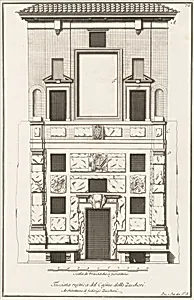
Medium
Printed book with engraved and etched illustrations
Dimensions
Overall: 19 11/16 x 15 3/8 x 1 3/16 in. (50 x 39 x 3 cm)
Classification
Books
Department
Drawings and Prints
Museum
Metropolitan Museum of Art, New York, NY
Credit
New York University Institute of Fine Arts Fund, 1958, transferred from the Library
Accession Number
1991.1073.13(1–4)
Rights
Public Domain
Tags
Art Historical Context
In the heart of the Enlightenment era, when Grand Tour travelers flocked to Italy to study classical antiquity, *Scelta di architetture antiche e moderne della città di Firenze* emerged as a treasured visual catalog of Florence's architectural wonders. Published in 1754, this lavish printed book—originally conceived by the celebrated Florentine architect Ferdinando Ruggieri—presents meticulously measured drawings of both ancient Roman ruins and Renaissance masterpieces, including works linked to Filippo Brunelleschi, the genius behind the Duomo's iconic dome. A collaborative masterpiece, it features contributions from esteemed artists like Giuseppe Zocchi, Bernardo Sansone Sgrilli, and others, blending their talents in a comprehensive homage to Tuscany's built heritage. The book's engraved and etched illustrations, rendered with extraordinary precision, capture the grandeur of Florence's palazzos, churches, and civic structures in intricate detail. Measuring a substantial 19⅝ × 15⅜ inches, its large-format pages allowed for sweeping vistas and technical elevations, making it an invaluable resource for architects, scholars, and collectors. Techniques like etching lent a fluid expressiveness to the stone textures and shadows, while engravings ensured sharp, reproducible accuracy—hallmarks of 18th-century topographical art. Housed in the Metropolitan Museum of Art's Drawings and Prints department, this volume underscores Florence's enduring role as the cradle of Western architecture, bridging antiquity and modernity for posterity. Visitors today can trace the city's evolution through its pages, marveling at how Ruggieri's vision inspired generations to preserve and celebrate la città del fiore.
About the Artist
Ferdinando Ruggieri|Bernardo Sansone Sgrilli|Theodor Verkruis|Carlo Faucci|Vincenzo Franceschini|Carlo Gregori|Giovanni Filippo Ciocchi|Giovanni Batista Nelli|Vincelaus Ramponi|Giuseppe Zocchi|Giuseppe Bouchard|Giuseppe Papini|Giovanni Domenico Ferretti|Giuseppe Ignazio Rossi|Filippo Brunelleschi (Italian|Italian|Italian|Italian|Dutch|Italian|Italian|Italian|Italian|Italian| |Italian|Italian|Italian|Italian) · 1739 |1377 |1691 |1733 |1646 |1729 |1680 |1719 |1692 |1661 | |1692 |1711 |0018 |0018 –1739 |1446 |1741 |1755 |1739 |1784 |1740 |1759 |1770 |1725 | |1768 |1767 |0018 |0018
died before 1739|Italian, 1377–1446|Italian, ca. 1691–1741|Italian, active 1733–55|Dutch, 1646–1739|Italian, 1729–ca. 1784|Italian, Rome, 1680–after 1740|Italian, Florence 1719–1759 Florence|1692–after 1770|Italian, 1661–1725| |Italian, Florence 1692–after 1768 Florence|Italian, Florence 1711–1767 Florence|active 18th century|Italian, active first half 18th century