
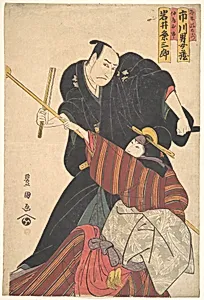
Scene from a Drama
Medium
Woodblock print; ink and color on paper
Dimensions
H. 15 1/8 in. (38.4 cm); W. 10 3/16 in. (25.9 cm)
Classification
Prints
Culture & Period
Japan · Edo period (1615–1868)
Department
Asian Art
Museum
Metropolitan Museum of Art, New York, NY
Credit
Rogers Fund, 1922
Accession Number
JP1407
Rights
Public Domain
Tags
Art Historical Context
Step into the vibrant world of-period Japan with *Scene from a Drama* (1804), a captivating woodblock print by Uawa Toyokuni I (1769–1825). This ink and color on paper masterpiece, measuring ⅛ × 10¼ inches, depicts actors in dynamic kabuki theater poses—men and women frozen mid-performance, their elaborate costumes and expressive faces bursting with life. Toyok, a master of thekiyo-e ("pictures of the floating world"), specialized in yakusha-e prints that celebrated the era's star performers, making theater accessible to everyday viewers. Created during the Edo period (1615–1868), when woodblock printing revolutionized Japanese art, this piece highlights the medium's ingenuity: artisans carved separate blocks for each color, layering vibrant hues with precision to achieve Toyokuni's signature bold outlines and dramatic shading. Affordable and mass-produced, such prints democratized beauty and entertainment, reflecting urban Japan's obsession with kabuki—a stylized drama blending music, dance, and role-playing where male actors portrayed all characters, including onnagata (female roles). Housed in the Metropolitan Museum of Art's Asian Art Department (Rogers Fund, 1922), this print offers a window into 19th-century Tokyo's cultural pulse, where art and theater intertwined to capture fleeting moments of passion and spectacle. A true gem for lovers of Japanese printmaking!
About the Artist
Utagawa Toyokuni I · 1777–1835
Japanese, 1777–1835