
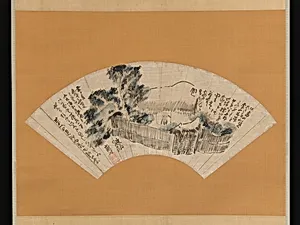
与謝蕪村筆 奥の細道図扇面|Scene from The Narrow Road to the Deep North
ca. 1780
Medium
Folding fan mounted as a hanging scroll; ink and color on paper
Dimensions
Image: 8 7/8 × 11 3/16 in. (22.6 × 28.4 cm) Overall with mounting: 40 in. × 20 15/16 in. (101.6 × 53.2 cm) Overall with knobs: 40 × 23 3/8 in. (101.6 × 59.3 cm)
Classification
Paintings
Culture & Period
Japan · Edo period (1615–1868)
Department
Asian Art
Museum
Metropolitan Museum of Art, New York, NY
Credit
Mary Griggs Burke Collection, Gift of the Mary and Jackson Burke Foundation, 2015
Accession Number
2015.300.159
Rights
Public Domain
Tags
Art Historical Context
Yosa Buson's *Scene from The Narrow Road the Deep North* (. 1780) captures a poignant moment from the famed haiku poet Matsuo Bash's 17th-century travelogue *Oku no Hosomichi*. This Edo-period masterpiece depicts humble travelers amid fences and rural landscapes, evoking the introspective journey through Japan's northern wilderness. Buson, a master of literati painting (nanga) and haikai poetry, infused his works with poetic lyricism, blending delicate ink washes and subtle colors to convey transience and harmony with nature—hallmarks of his style that bridged Japanese and Chinese artistic traditions. Painted on a folding fan and later mounted as a hanging scroll, the artwork exemplifies Japan's innovative repurposing of everyday objects into display pieces. Fans were prized for their portability and intimacy, allowing artists like Buson to compose intricate scenes on compact surfaces (here, just 8⅞ × 11¼ inches). The ink and light color on paper technique highlights Buson's precision, with misty atmospheres and sparse figures that invite contemplation, much like Bashō's haiku. Housed in the Metropolitan Museum of Art's Mary Griggs Burke Collection, this piece reflects the cultural reverence for waka and haiku literature during the Edo period (1615–1868), when such fan paintings became cherished tokens of literary devotion. A window into Japan's poetic soul, it reminds us of journeys both physical and spiritual.