
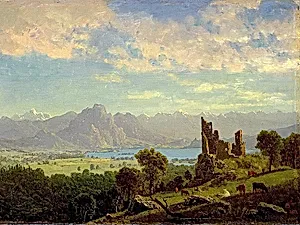
Scene in the Tyrol
Classification
Painting
Department
Smithsonian Collection
Museum
Smithsonian American Art Museum
Credit
Hirshhorn Museum and Sculpture Garden, Smithsonian Institution, Washington, DC, Gift of Joseph H. Hirshhorn, 1966
Accession Number
66.508
Rights
Public Domain
About this artwork
Robert S. Sloan Gallery, New York, to 1964
Art Historical Context
Albert Bierstadt's *Scene in the Tyrol* (1854) captures the majestic alpine landscapes of the Tyrol region, spanning parts of modern-day Austria, Germany, and Italy. Born in Solingen, Germany, in 1830 and later emigrating to the United States, Bierstadt was in the early stages of his career during this period. Fresh from studies at the Düsseldorf Academy—a hub for Romantic landscape painters—he traveled through Europe, sketching dramatic mountain vistas that would foreshadow his later fame. This painting, created when he was just 24, reflects his emerging mastery of luminous, detailed natural scenes, hallmarks of the Hudson River School movement he helped define upon returning to America. As an oil painting (medium details elusive but typical of his precise, atmospheric style), it exemplifies Bierstadt's technique of using light to evoke grandeur and sublime beauty, drawing viewers into the vastness of nature. Though focused on European terrain rather than the American West for which he's best known, it highlights his lifelong passion for portraying wilderness as a spiritual force. Acquired from the Robert S. Sloan Gallery in New York by 1964 and gifted to the Hirshhorn Museum and Sculpture Garden in 1966, it now resides in the Smithsonian American Art Museum's collection. This early gem offers a glimpse into Bierstadt's roots, bridging Old World Romanticism with the New World's frontier spirit—perfect for pondering how personal journeys shape artistic legacies.