
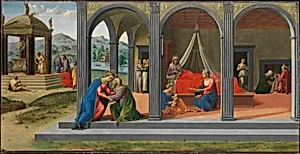
Scenes from the Life of Saint John the Baptist
Medium
Tempera, oil, and gold on wood
Dimensions
30 9/16 x 59 1/2 in. (77.6 x 151.1 cm)
Classification
Paintings
Department
European Paintings
Museum
Metropolitan Museum of Art, New York, NY
Credit
Purchase, Gwynne Andrews, Harris Brisbane Dick, Dodge, Fletcher, and Rogers Funds, funds from various donors, Ella Morris de Peyster Gift, Mrs. Donald Oenslager Gift, and Gifts in memory of Robert Lehman, 1970
Accession Number
1970.134.1
Rights
Public Domain
Tags
Art Historical Context
Francesco Granacci (1469–1543), a prominent Florentine painter trained in the workshop of Domenico Ghirlandaio alongside masters like Michelangelo, created *Scenes from the Life of John the Baptist* around1506–7. This wide-format panel, executed in tempera, oil, and gold wood (30 9/16 x 59 1/2 in.), captures key moments from the Baptist's early life, likely including his birth and infancy, as suggested by motifs of infants, women, beds, bedrooms, and the Virgin Mary. Granacci's work reflects the High Renaissance's blend of narrative storytelling and humanistic detail, bridging late Quattrocento traditions with emerging innovations. The mixed medium is noteworthy: tempera provides luminous detail and durability on wood panels, while oil adds depth and realism to flesh tones and drapery—techniques Granacci absorbed from Leonardo da Vinci's influence. Gold leaf, a hallmark of sacred art, enhances the divine aura, evoking the opulence of Renaissance altarpieces or predellas. Commissioned in Florence during a flourishing of religious art, the painting underscores devotion to John the Baptist, the precursor to Christ, amid the city's vibrant artistic scene. Today, housed in the Metropolitan Museum of Art's European Paintings department, this acquired masterpiece (1970) invites visitors to ponder the intimate, miraculous beginnings of a pivotal biblical figure, rendered with Granacci's graceful figures and vibrant storytelling.