
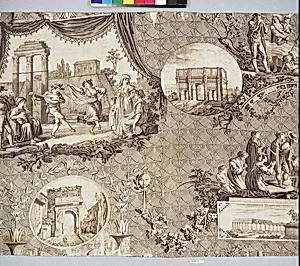
Scènes romaines
19th century
Medium
Cotton
Dimensions
L. 20 3/4 x W. 28 1/4 inches 52.7 x 71.8 cm
Classification
Textiles-Printed
Culture
French, Jouy-en-Josas
Department
European Sculpture and Decorative Arts
Museum
Metropolitan Museum of Art, New York, NY
Credit
Rogers Fund, 1913
Accession Number
13.69.33
Rights
Public Domain
Tags
Art Historical Context
"Scènes romaines," by the renowned Oberkampf Manuf in Jouy-en-J, France, during the 19th century captures the elegance of neoclassical reverie through vibrant printed cotton. This textile panel, measuring about 21 by 28 inches, depicts lively Roman scenes featuring men and women dancing amid musical instruments evoking the grandeur of ancient festivities. Designed with input from artist Bartolomeo Penelli it exemplifies the manufactory's mastery in creating "toiles de Jouy"—iconic monochromatic prints on white cotton grounds that adorned homes across Europe and beyond. The Oberkampf Manufactory, founded in the 18th century by Christophe-Philippe Oberkampf, revolutionized textile printing with copperplate techniques, allowing intricate, multi-color designs on cotton that were both affordable and luxurious. By the 19th century, these prints had evolved to include exotic and historical themes like Roman life, reflecting France's fascination with classical antiquity amid Napoleonic influences. Classified as a printed textile in the Metropolitan Museum of Art's European Sculpture and Decorative Arts collection (acquired via Rogers Fund in 1913), "Scènes romaines" highlights the cultural role of such fabrics in interior decoration, from upholstery to fashion. This piece invites visitors to appreciate how everyday cotton became a canvas for storytelling, blending artistry with industrial innovation in 19th-century France.