
Sceptre
Unknown Artist
Medium
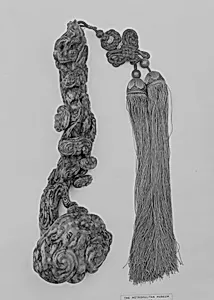
Jadeite, pea-green with slight mixture of emerald-green and much flecked with black
Dimensions
H. 10 9/16 in. (26.8 cm); W. 3 3/4 in. (9.6 cm); L. 2 5/16 in. (5.9 cm)
Classification
Jade
Culture & Period
China · Qing dynasty (1644–1911), Qianlong period (1736–95)
Department
Asian Art
Museum
Metropolitan Museum of Art, New York, NY
Credit
Gift of Heber R. Bishop, 1902
Accession Number
02.18.523
Rights
Public Domain
Art Historical Context
This exquisite jadeite sceptre carved from pea-green stone subtly veined with emerald-green andcked with black, the masterful lapidary arts of China's Qing dynasty during the Qianlong period (173695). Measuring about 10½ inches in height, its graceful form and polished surfaces highlight the material's natural translucency and durability, prized qualities in imperial workshops. Though the artist remains unknown, such pieces were likely produced in the emperor's own jade factories, where craftsmen transformed raw boulders into symbols of refined elegance. In Qing imperial culture, jade held profound significance as an emblem of purity, moral virtue, and authority—qualities embodied by the sceptre's imposing yet harmonious design. During Qianlong's long reign, a golden age for Chinese arts, jade carving reached unprecedented sophistication, with sceptres often used in rituals or as tokens of power and good fortune. This rare jadeite example, sourced possibly from Burmese mines newly accessible to China, underscores the era's taste for vibrant, heterogeneous stones over the more common nephrite. Generously gifted to the Metropolitan Museum of Art in 1902 by Heber R. Bishop, this sceptre invites visitors to ponder the splendor of Qianlong's court, where art and symbolism intertwined to affirm dynastic glory.