
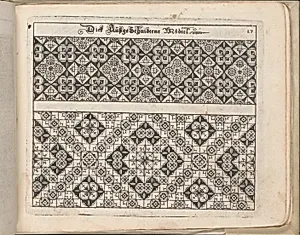
Schön Neues Modelbuch (Page 32 recto)
Medium
Etching
Dimensions
Overall: 6 1/8 x 7 13/16 in. (15.5 x 19.8 cm)
Classification
Books|Prints|Ornament & Architecture
Department
Drawings and Prints
Museum
Metropolitan Museum of Art, New York, NY
Credit
Rogers Fund, 1920
Accession Number
20.16(32r)
Rights
Public Domain
Tags
Art Historical Context
**Schön Neues Modelbuch ( 32 recto)**, created in 1597 by engraver Johann Sibmacher with involvement from printer Balthasar Caymox, exemplifies vibrant world of Renaissance pattern books from Nuremberg, Germany. This etching, measuring 6 1/8 x 7 13/16 inches, is a page from Sibmacher's *Beautiful New Pattern Book*, a treasured resource for artisans crafting lace, embroidery, and textiles. Such *Modelbücher* democratized intricate designs, spreading ornamental motifs across Europe and fueling the decorative arts boom of the late 16th century. Etching's precision—acid biting into metal plates—allowed Sibmacher to render delicate interlacing straps, floral scrolls, and geometric knots with remarkable clarity, ideal for scalable patterns. Page 32 recto showcases these ornamental elements, blending Gothic echoes with emerging Renaissance flourish, reflecting Nuremberg's status as a printmaking hub. These books weren't just practical; they preserved cultural motifs, influencing fashion, architecture, and even bookbinding. Today, housed in The Metropolitan Museum of Art's Drawings and Prints department (Rogers Fund, 1920), this work highlights how print technology empowered craftspeople, bridging fine art and everyday creativity in a pre-industrial age. A window into Renaissance ingenuity!
About the Artist
Johann Sibmacher|Balthasar Caymox · 1590–1611
Johann Sibmacher (c. 1561–1611), also rendered as Johann Ambrosius Siebmacher, was a German copperplate engraver, etcher, and publisher based in Nuremberg whose contributions to heraldic art and decorative pattern design left a legacy that outlasted him by centuries. Active from around 1590 until his death in 1611, Sibmacher worked at the heart of Nuremberg's flourishing book and print trade, a ci...