
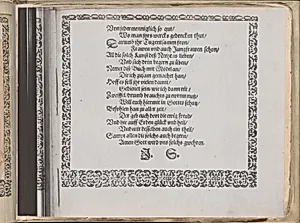
Schön Neues Modelbuch (Page 5 recto)
Medium
Woodcut (facsimile)
Dimensions
Overall: 6 1/8 x 7 13/16 in. (15.5 x 19.8 cm)
Classification
Books|Prints|Ornament & Architecture
Department
Drawings and Prints
Museum
Metropolitan Museum of Art, New York, NY
Credit
Rogers Fund, 1920
Accession Number
20.16(5r)
Rights
Public Domain
Art Historical Context
This 1597 woodcut from *Schön Neues Modelbuch* (Beautiful New Model Book) represents the vibrant tradition of printed pattern books that flourished in late Renaissance Europe. Created by Johann Sibmacher and published by Balthasar Caymox, the page belongs to a practical guide offering intricate designs for embroidery, lace, and other decorative needlework. As a facsimile reproduction, it preserves the crisp lines and repeatable motifs that allowed artisans across regions to copy and adapt fashionable patterns for clothing, household linens, and furnishings. Woodcut printing proved ideal for such model books because the durable blocks could produce numerous affordable impressions, spreading ornamental ideas from urban centers to workshops and homes. Sibmacher’s designs reflect the period’s taste for symmetrical, nature-inspired motifs—scrolling vines, flowers, and geometric frames—that blended functionality with aesthetic elegance. These publications played a key role in democratizing design knowledge during an era when printed images were transforming craft traditions. Housed in the Metropolitan Museum’s collection of ornament and architecture prints, this page highlights how 16th-century model books bridged fine art and applied crafts, influencing everything from domestic textiles to architectural decoration. Its modest size belies its lasting cultural impact as both a working tool and a record of Renaissance decorative imagination.
About the Artist
Johann Sibmacher|Balthasar Caymox · 1590–1611
Johann Sibmacher (c. 1561–1611), also rendered as Johann Ambrosius Siebmacher, was a German copperplate engraver, etcher, and publisher based in Nuremberg whose contributions to heraldic art and decorative pattern design left a legacy that outlasted him by centuries. Active from around 1590 until his death in 1611, Sibmacher worked at the heart of Nuremberg's flourishing book and print trade, a ci...