
Scorpion
Unknown Artist
6th–7th century
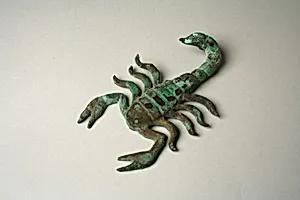
Medium
Gilded copper
Dimensions
Length 4-1/8 in. (10.5 cm)
Classification
Metal-Ornaments
Culture
Moche
Department
Arts of Africa, Oceania, and the Americas
Museum
Metropolitan Museum of Art, New York, NY
Credit
Gift of Jane Costello Goldberg, from the Collection of Arnold I. Goldberg, 1981
Accession Number
1981.459.6
Rights
Public Domain
Tags
Art Historical Context
Behold the intricate *Scorpion*, a masterful copper ornament from the Moche culture of ancient Peru crafted between the 6th and 7th centuries. Measuring just 4-1/8 inches (10.5 cm) in length, this delicate metalwork captures the fierce form of a scorpion with remarkable precision, its segmented body and arched tail gleaming from the application of gold over copper. As a piece from the Metropolitan Museum of Art's Department of Arts of Africa,, and the Americas, exemplifies the Moche's exceptional skill in jewelry and adornments. The Moche, flourishing on Peru's northern coast from around 100–800 CE, were renowned for their advanced metallurgy, producing ornaments worn by elites in rituals or daily life. Gilding—likely achieved through depletion gilding or hammering thin gold sheets—elevated base copper to a luxurious sheen, symbolizing wealth and divine power. Scorpions appear frequently in Moche iconography, possibly evoking themes of protection, danger, or the natural world, reflecting the culture's deep connection to its arid environment and spiritual beliefs. This gift from Jane Costello Goldberg's collection invites us to marvel at the Moche's artistic legacy, where everyday creatures became emblems of ingenuity and cultural vitality. A true treasure for any visitor!