
Screen of Poplars
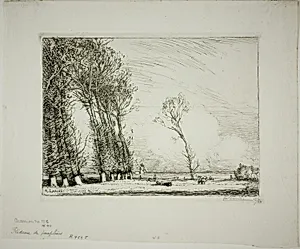
Medium
Etching on cream laid paper
Dimensions
Image: 13.8 × 18.7 cm (5 7/16 × 7 3/8 in.); Plate: 14.8 × 19.3 cm (5 7/8 × 7 5/8 in.); Sheet: 21.2 × 25.6 cm (8 3/8 × 10 1/8 in.)
Classification
etching
Department
Prints and Drawings
Museum
Art Institute of Chicago
Accession Number
135934
Rights
Public Domain
Art Historical Context
**Screen of Poplars** is a delicate etching by French artist Louis Auguste Lepère created in 1911 housed in the Art Institute of's Prints and Drawings Department. Lepère (1849–1918), a master printmaker influenced by Japanese woodcuts and contemporaries like Whistler, captured the subtle beauty of nature with precise lines and atmospheric depth. This intimate work, measuring just 13.8 × 18.7 cm in its image area, exemplifies his skill in rendering everyday landscapes on cream laid paper—a traditional support prized for its textured surface that enhances the etching's tactile quality. Etching, Lepère's favored medium, involves coating a metal plate with acid-resistant ground, scratching designs into it, and immersing it in acid to etch lines of varying depth. When inked and printed, these create rich tonal contrasts, evoking the dappled light filtering through a "screen" of slender poplar trees—a motif echoing the poetic rural scenes of French Impressionism. Though small, the plate's marks (14.8 × 19.3 cm) extend the composition's elegance across the 21.2 × 25.6 cm sheet. Produced on the eve of World War I, this print reflects Lepère's lifelong dedication to preserving France's countryside amid rapid modernization. Visitors will appreciate its quiet invitation to linger on nature's graceful forms, a testament to etching's enduring power as both art and craft.
About the Artist
Louis Auguste Lepère · 1849–1918
Louis-Auguste Lepère (1849–1918) was born in Paris on November 30 to the sculptor François Lepère, immersing him early in the artistic world. At age thirteen, he apprenticed in the studio of the English wood engraver Joseph Burn-Smeeton, training there from 1862 to 1867, and later attended drawing courses under Horace Lecoq de Boisbaudran at the Petite École (now École nationale supérieure des art...