
Scrimshaw: Walrus Tusk
1941
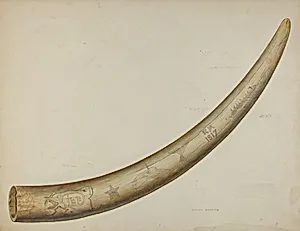
Medium
watercolor, graphite, and pen and ink on paper
Dimensions
overall: 45.9 x 59 cm (18 1/16 x 23 1/4 in.) Original IAD Object: 5" long
Classification
Index of American Design
Department
CG-W
Museum
National Gallery of Art, Washington, D.C.
Credit
Index of American Design
Accession Number
1943.8.13722
Rights
Public Domain
Art Historical Context
This vibrant watercolor rendering, titled *Scrimshaw: Walrus Tusk*, was created in 1941 by artist Oscar Bluhme as part of the Index of American Design (IAD), a groundbreaking WPA Federal Art Project from the 1930s and 1940s. The IAD commissioned over 15,000 precise illustrations to document America's rich folk and decorative arts, preserving objects that might otherwise be lost to time. Bluhme's detailed depiction captures a 5-inch-long walrus tusk adorned with intricate scrimshaw engravings—a traditional maritime craft practiced by whalers and sailors using whalebone, ivory, or tusks as canvas. Measuring 45.9 x 59 cm, the work masterfully employs watercolor for subtle tones, graphite for shading, and pen and ink for fine lines, mimicking the tusk's creamy texture and etched motifs. Housed in the National Gallery of Art's collection, it exemplifies the IAD's commitment to technical accuracy and artistic beauty, bridging utilitarian craft with fine art. Scrimshaw holds cultural significance as a testament to the ingenuity of 19th-century American seafarers, who transformed idle hours at sea into personalized art—often featuring patriotic scenes, ships, or native motifs. Bluhme's rendering not only safeguards this vanishing tradition but invites us to appreciate the intersection of labor, leisure, and legacy in American design.