
Scrubbing Woman
1844
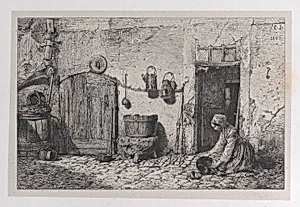
Medium
Etching
Dimensions
Sheet: 9 1/4 × 11 5/8 in. (23.5 × 29.5 cm) Plate: 5 13/16 × 8 1/4 in. (14.8 × 21 cm)
Classification
Prints
Department
Drawings and Prints
Museum
Metropolitan Museum of Art, New York, NY
Credit
Harris Brisbane Dick Fund, 1927
Accession Number
27.10.23
Rights
Public Domain
Art Historical Context
**Scrubbing Woman** (1844) is a delicate etching by French artist Charles Jacque, a figure in the Barbizon School. This print captures a humble moment of daily life: a woman intently scrubbing, likely evoking the rhythms of peasant labor in rural France. Jacque, known for his realistic depictions of countryside scenes and working folk, used etching to immortalize these overlooked subjects with remarkable precision. Measuring just 5 13/16 × 8 1/4 inches on the plate, the scale draws viewers close, inviting empathy for the figure's quiet diligence. Created amid the social upheavals of mid-19th-century France, the work reflects Barbizon artists' shift from idealized Romanticism toward truthful portrayals of nature and ordinary people—a precursor to Impressionism. Etching, Jacque's favored medium, involved biting acid into a metal plate to create fine, expressive lines, allowing for rich textures in the woman's clothing and the scrubbed surface. This technique not only enabled affordable multiples but also highlighted subtle details, like the play of light on worn fabrics. Today, housed in the Metropolitan Museum of Art's Drawings and Prints department (thanks to the Harris Brisbane Dick Fund, 1927), **Scrubbing Woman** reminds us of art's power to dignify everyday toil, bridging viewers to the resilient spirit of 19th-century laborers.
About the Artist
Charles Jacque · 1813–1894
Charles-Émile Jacque (1813–1894) was a pioneering French painter, engraver, and illustrator whose career bridged the worlds of printmaking and pastoral painting. Born in Paris amid a difficult childhood, he apprenticed at age seventeen to a map engraver, mastering drypoint technique and producing his first etching in 1830—a copy of a head after Rembrandt. After serving seven years in the French Ar...