
Medium
Hand-colored etching and aquatint
Dimensions
Sheet: 5 1/2 × 8 3/16 in. (14 × 20.8 cm)
Classification
Prints
Department
Drawings and Prints
Museum
Metropolitan Museum of Art, New York, NY
Credit
The Elisha Whittelsey Collection, The Elisha Whittelsey Fund, 1959
Accession Number
59.533.1620(12)
Rights
Public Domain
Tags
Art Historical Context
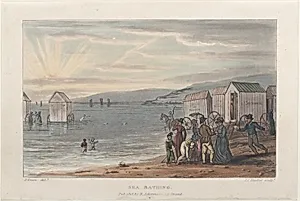
"Sea Bathing," a vibrant hand-colored etching and aquint from 1813, captures a lively beach scene by a collaborative team of British printmakers: James Green, Thomas Rowlandson Rudolph Ackermann of London, and Joseph Constantineler. Rowlandson, renowned for his caricatures, likely contributed the humorous figures, while Stadler's aquatint technique added rich tonal depths mimicking watercolor washes. Published by Ackermann, a leading innovator in color printing, this compact print (5½ × 8¼ inches) offers a window into Regency-era leisure. The artwork depicts men and women enjoying sea bathing, a trendy health fad popularized in the early 19th century at coastal resorts like Brighton. Bathing machines—wheeled huts that wheeled bathers into the surf for modesty—were de rigueur, reflecting emerging social norms around gender separation and propriety amid the era's growing seaside tourism boom. This medium was revolutionary for its time, blending etching's fine lines with aquatint's painterly effects and hand-coloring for vivid appeal, making affordable art accessible to the middle class. Housed in the Metropolitan Museum of Art's Elisha Whittelsey Collection, "Sea Bathing" whimsically documents a playful cultural shift, blending satire with the simple joys of summer by the sea.
About the Artist
James Green|Thomas Rowlandson|Rudolph Ackermann, London|Joseph Constantine Stadler (British|American) · 1771 |1738 –1834 |1820
British, Leytonstone 1771–1834 Bath|American, Swarthmore, Pennsylvania 1738–1820 London