
Sea Dragon
Unknown Artist
17th century
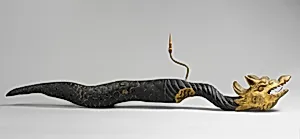
Medium
Wood, brass, gilding
Dimensions
Height: 54 1/2 in. (138.4 cm) Width: 8 in. (20.3 cm) Depth: 3 1/2 in. (8.9 cm)
Classification
Aerophone-Reed Vibrated-double reed
Culture
Italian
Department
Musical Instruments
Museum
Metropolitan Museum of Art, New York, NY
Credit
The Crosby Brown Collection of Musical Instruments, 1889
Accession Number
89.4.881a–c
Rights
Public Domain
Tags
Art Historical Context
Behold the *Sea Dragon*, a whimsical 17th-century Italian musical instrument from the Metropolitan Museum Art's Crosby Brown Collection of Musical Instruments, acquired in 1889. Crafted from wood, brass, and intricate gilding, thisophone—classified as a double-reed instrument—stands an impressive 54½ inches tall, slender at 8 inches wide and3½ inches deep. fantastical form, evoking a serpentine sea dragon with coiled body and fierce jaws, transforms a functional object into a work of Baroque artistry, blending sculpture and sound. In Renaissance and Baroque Italy, makers often adorned woodwinds like shawms or oboes with mythical motifs to delight performers and audiences at courts and festivals. The double-reed mechanism, vibrated by air to produce a piercing, reedy tone, would have cut through ensembles, while the gilded brass accents and carved wooden details showcased exceptional craftsmanship. This fusion of utility and fantasy highlights the era's love for the grotesque and marvelous, turning music-making into visual spectacle. Today, the *Sea Dragon* captivates as a rare survivor of opulent instrument design, reminding us how 17th-century Italians infused everyday arts with wonder. Though its anonymous creator remains unknown, the piece endures as a gilded bridge between sound and myth.