
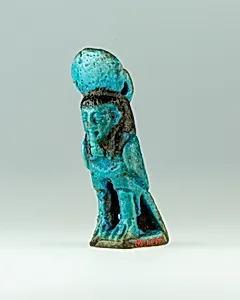
Seal amulet of Ba bird
Unknown Artist
30 B.C.–A.D. 364
Medium
Faience
Dimensions
h. 4.7 cm (1 7/8 in); w. 1.7 cm (11/16 in)
Classification
Seal amulet, Ba bird
Period
Roman Period
Department
Egyptian Art
Museum
Metropolitan Museum of Art, New York, NY
Credit
Rogers Fund, 1932
Accession Number
32.1.212
Rights
Public Domain
Art Historical Context
This delicate seal amulet, depicting the Ba bird, h from Egypt's Roman Period (30 B.C.–A.D. 364), a time when ancient pharaonic traditions blended with Roman influences. Crafted from faience—a vibrant, glazed ceramic prized for its turquoise hues mimicking lapis lazuli or turquoise—the amulet measures just 4.7 cm high and 1.7 cm wide, perfect for wearing as jewelry or using as a personal seal. Faience's glassy frit body and colorful glaze not only made it affordable but also imbued it with protective, life-affirming qualities, evoking eternity and rebirth. The Ba bird, shown here with its distinctive human head and avian body, embodies a key aspect of the Egyptian soul: the mobile spirit that could traverse the afterlife and return to nourish the mummy. Amulets like this served dual purposes—magical safeguards against evil and practical seals for documents or containers—reflecting everyday spirituality in Roman Egypt. Such objects highlight how deeply rooted religious beliefs persisted amid imperial rule. Acquired through the Rogers Fund in 1932, this piece from the Metropolitan Museum of Art's Egyptian Art collection offers a window into personal devotion and artistry in a transitional era, reminding us of Egypt's enduring mystical legacy.