
Seal Box
Unknown Artist
3rd century
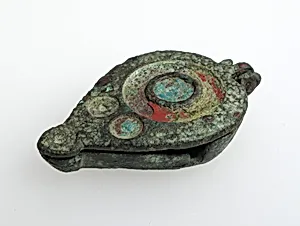
Medium
Champlevé enamel, bronze
Dimensions
Overall: 1 3/16 x 11/16 x 1/4 in. (3 x 1.8 x 0.6 cm)
Classification
Enamels-Champlevé
Culture
Roman
Department
Medieval Art
Museum
Metropolitan Museum of Art, New York, NY
Credit
Gift of Ruth and Victoria Blumka, 1988
Accession Number
1988.408.2a, b
Rights
Public Domain
Art Historical Context
This exquisite *Seal Box* from the3rd century exemplifies the refined artistry of late Roman craftsmanship. Crafted by an unknown artist, this diminutive bronze container—measuring just 1 3/16 x 11/16 x 1/4 inches—was likely designed to hold engraved seals (intaglios) used for stamping wax on documents, letters, or valuables. Its portability made it a practical accessory for Roman elites, travelers, or officials in an era when secure communication and authentication were vital amid the empire's vast bureaucracy. The standout feature is its champlevé enamel technique, an early innovation where troughs were carved into the bronze base and filled with fused glass powders in vibrant colors, then fired to create durable, jewel-like patterns. While champlevé enameling flourished in the medieval period, this piece represents a rare Roman precursor, bridging ancient metalwork with later European traditions. Housed in the Metropolitan Museum of Art's Medieval Art department (gift of Ruth and Victoria Blumka, 1988), it highlights how Roman artisans pushed technical boundaries, blending functionality with opulent decoration. Imagine slipping this tiny treasure into your pocket— a snapshot of Roman ingenuity that endured through centuries, now inviting us to ponder the daily lives of those who once safeguarded their secrets within.