
Seal-top spoon
Unknown Artist
ca. 1640
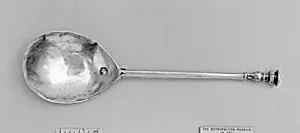
Medium
Silver, originally gilt
Dimensions
6 1/2 × 2 1/2 in. (16.5 × 6.4 cm)
Classification
Metalwork-Silver
Culture
British, provincial
Department
European Sculpture and Decorative Arts
Museum
Metropolitan Museum of Art, New York, NY
Credit
Rogers Fund, 1913
Accession Number
13.42.100d
Rights
Public Domain
Art Historical Context
This elegant seal-top spoon, crafted around 1640 in provincial Britain, exemplifies the fine metalwork of 17th-century England outside major urban centers like London. Made of silver and originally gilded for a warm, golden sheen, it measures a modest 6½ × 2½ inches, designed for practical dining yet elevated by its decorative finial—a characteristic "seal" or balled top that gave the style its name. Such spoons were prized possessions, often hallmarks of social status amid the turbulent times of the English Civil War. The provincial origin highlights regional silversmithing traditions, where skilled artisans produced high-quality pieces rivaling metropolitan work, using techniques like chasing and gilding to enhance durability and luxury. Gilding, achieved by applying a thin gold layer over silver, not only protected against tarnish but added opulence for the table. Today, housed in The Metropolitan Museum of Art's European Sculpture and Decorative Arts Department (acquired via the Rogers Fund in 1913), it offers a glimpse into everyday life transformed into art through masterful craftsmanship.