
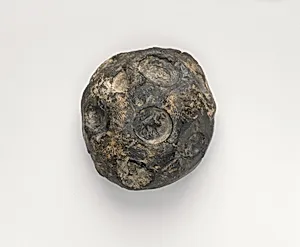
Sealing
Unknown Artist
ca. 7th century CE
Medium
Un-baked clay
Dimensions
1 3/4 in. × 1 3/4 in. × 1 in. (4.5 × 4.4 × 2.5 cm)
Classification
Clay-Sealings
Culture & Period
Sasanian · Sasanian
Department
Ancient Near Eastern Art
Museum
Metropolitan Museum of Art, New York, NY
Credit
Rogers Fund, 1936
Accession Number
36.30.250
Rights
Public Domain
Tags
Art Historical Context
This delicate clay sealing, crafted around the 7th century CE during the Sasanian period, offers a glimpse into the administrative heart of ancient Iran's last pre-Islamic empire. Measuring just 1¾ × 1¾ × 1 inches, this un-baked clay impression—likely stamped from an intaglio seal—was used to secure documents, containers, or doors, much like a modern wax seal. Its fragile, unfired state preserved the fine details of its camel motif, a nod to the vital role these resilient beasts played in Sasanian trade caravans along the Silk Road. Sasanian art often featured animals symbolizing power, fertility, and commerce, and camels were especially prominent, evoking the empire's vast networks from Mesopotamia to Central Asia. These sealings were everyday tools of bureaucracy in a sophisticated society known for Zoroastrianism, grand rock reliefs, and silverwork, underscoring the blend of artistry and utility in governance. Acquired through the Rogers Fund in 1936, this piece now resides in the Metropolitan Museum of Art's Ancient Near Eastern collection, reminding us how tiny artifacts illuminate mighty civilizations.