
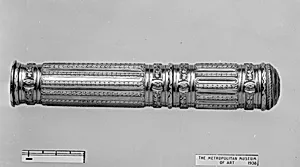
Sealing wax case (étui)
Unknown Artist
1777–78
Medium
Gold
Dimensions
Length: 4 3/4 in. (12.1 cm)
Classification
Metalwork-Gold and Platinum
Culture
French, Paris
Department
European Sculpture and Decorative Arts
Museum
Metropolitan Museum of Art, New York, NY
Credit
Bequest of Kate Read Blacque, in memory of her husband, Valentine Alexander Blacque, 1937
Accession Number
38.50.33a, b
Rights
Public Domain
Art Historical Context
Step into the opulent world of 18th-century French aristocracy with this exquisite sealing wax case, or *étui*, crafted in Paris around 1777–78. Measuring just 4 3/4 inches long, this delicate gold container was designed to hold sealing wax for affixing personal seals to letters—a refined ritual of correspondence before modern envelopes. Fashionable accessories like this were essential for ladies of the court, blending practicality with lavish display during the lavish final years of the Ancien Régime under Louis XVI. Goldsmiths in Paris, the epicenter of European luxury metalwork, elevated such *étuis* into miniature masterpieces. This piece exemplifies the era's masterful techniques in goldsmithing, likely featuring intricate chasing, engraving, or enamel work (common in surviving examples), showcasing the transition from exuberant Rococo curves to emerging Neoclassical elegance. Its shimmering surface would have caught the candlelight in a salon, symbolizing wealth, taste, and social status. Bequeathed to the Metropolitan Museum of Art in 1937 by Kate Read Blacque in memory of her husband, this *étui* offers a tangible glimpse into pre-Revolutionary refinement. Though by an unknown artist, it embodies the anonymous brilliance of Parisian ateliers, where craftsmanship spoke louder than signatures. A true jewel of European decorative arts!