
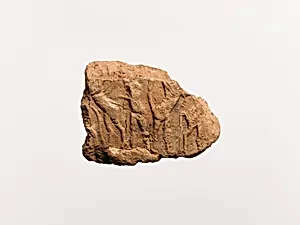
Sealing with cylinder seal impression
Unknown Artist
ca. 2900–2600 BCE
Medium
Clay
Dimensions
1 7/16 × 1 7/8 × 3/4 in. (3.6 × 4.8 × 1.9 cm)
Classification
Clay-Sealings
Culture & Period
Sumerian · Early Dynastic I-II
Department
Ancient Near Eastern Art
Museum
Metropolitan Museum of Art, New York, NY
Credit
Rogers Fund, 1962
Accession Number
62.70.91
Rights
Public Domain
Tags
Art Historical Context
This delicate clay sealing from Sumerian Early Dynastic I-II (ca. 2900–2600 BCE) captures the ingenuity of one of the world's earliest civilizations. Rolled with a cylinder seal—a small, carved stone cylinder rotated across soft clay—this impression served as a practical security device. Sumerians in ancient Mesopotamia used such sealings to authenticate clay envelopes, jars, or documents, preventing tampering in bustling trade and administrative hubs like Uruk or Ur. The artwork's miniature scale (just 1 7/16 × 1 7/8 × 3/4 in.) belies its cultural weight. Featuring human figures, it reflects the period's emerging complexity: gods, kings, and worshippers often populated these vignettes, blending daily life with mythology. Cylinder seal art was a pinnacle of micro-sculpture, demanding precise carving to convey narratives in intaglio relief—pressed into clay to create raised designs. This technique preserved Sumerian iconography for posterity, offering glimpses into their worldview long before writing dominated records. Acquired through the Rogers Fund in 1962, this piece at the Metropolitan Museum of Art invites us to marvel at Sumer's legacy: a society that sealed its story in clay, laying foundations for bureaucracy, art, and urban life that echo through millennia.