
Seascape (Gravelines)
1890
Medium
oil on wood
Dimensions
overall (inner panel): 16 x 25 cm (6 5/16 x 9 13/16 in.) overall (including painted frame): 21.5 × 30.5 cm (8 7/16 × 12 in.) depth (thickness of cradled panel): 1 cm (3/8 in.) framed: 34.29 × 43.18 × 5.87 cm (13 1/2 × 17 × 2 5/16 in.)
Classification
Painting
Department
CF
Museum
National Gallery of Art, Washington, D.C.
Credit
Collection of Mr. and Mrs. Paul Mellon
Accession Number
2012.89.8
Rights
Public Domain
Art Historical Context
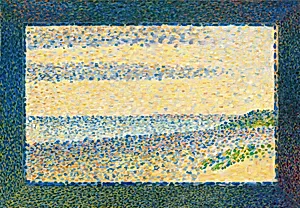
Georges Seurat’s *Seascape (Gravelines)* exemplifies the meticulous approach of Neo-Impressionism, a movement the artist helped pioneer in the late nineteenth century. Working in 1890, just a year before his untimely death, Seurat applied his signature Pointillist technique—placing tiny dots of pure color side by side so that the viewer’s eye mixes them optically. This method creates a luminous, vibrating surface that captures the quiet atmosphere of the French coastal town of Gravelines, a modest port near the Belgian border. Painted in oil on a small wood panel measuring just 16 by 25 centimeters, the work feels intimate and portable, likely executed outdoors during one of Seurat’s summer sketching campaigns. The artist extended his optical experiments to the frame itself, painting a border of complementary colors directly onto the panel—an innovative choice that unifies the composition and softens the transition between image and surroundings. Today in the collection of the National Gallery of Art, this modest yet radiant panel demonstrates Seurat’s belief that even the simplest harbor view could become a carefully orchestrated harmony of color and light.
About the Artist
Georges Seurat · 1859–1891
Georges Seurat (1859-1891) was the founder of Neo-Impressionism and the inventor of Pointillism, a revolutionary technique that transformed how artists understand and apply color. In a tragically brief career cut short at age 31, Seurat produced only seven monumental paintings, yet his systematic application of color theory fundamentally altered the direction of modern art. Born in Paris to a pro...