
Seasons and Elements (Air) (set of four)
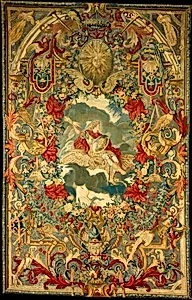
Medium
Canvas; silk, wool, and metal-thread embroidery in tent stitch (316 stitches per sq. inch, 49 stitches per sq. cm.)
Dimensions
L. 168 x W. 108 in. (426.7 x 274.3 cm)
Classification
Textiles-Embroidered
Culture
French, Paris
Department
European Sculpture and Decorative Arts
Museum
Metropolitan Museum of Art, New York, NY
Credit
Rogers Fund, 1946
Accession Number
46.43.4
Rights
Public Domain
Tags
Art Historical Context
This exquisite embroidered panel, *Seasons and Elements ()*, is one of a grand set of four created around 1683 in Paris. Designed by court artists Charles Le Brun—Louis XIV's principal painter—and Jean Lemoyen le Lorr, it was likely commissioned or patronized by the Marquise Montespan, the Sun King's influential favorite. Produced at the Convent of Saint-de-la-Providence these massive works (over 14 feet long) embody the opulent Baroque style of Versailles, blending mythology and nature with symbols like Jupiter, parrots, birds, roses, and the sun—evoking Louis XIV's divine radiance. The medium is a tour de force of French decorative arts: canvas worked in tent stitch with silk, wool, and shimmering metal threads, achieving an astonishing 316 stitches per square inch (49 per square cm). This hyper-detailed technique rivals painting, capturing airy motifs with lifelike vibrancy and texture, perfect for draping royal interiors. Housed in The Metropolitan Museum of Art's European Sculpture and Decorative Arts collection (Rogers Fund, 1946), this panel highlights women's skilled labor in convents and the era's fusion of art, power, and piety. A testament to 17th-century technical mastery, it invites visitors to marvel at embroidery's elevation to high art.
About the Artist
Charles Le Brun|Jean Lemoyen le Lorrain|Convent of Saint Joseph-de-la-Providence, Paris|Marquise de Montespan · 1619–1690
Charles Le Brun (1619–1690) was the most powerful artistic figure in seventeenth-century France, serving as the virtual dictator of official taste during the reign of Louis XIV and shaping the visual identity of the French Baroque in ways that resonated for generations. Born in Paris, he trained under the painter Simon Vouet before traveling to Rome in 1642, where he studied the works of Nicolas P...