
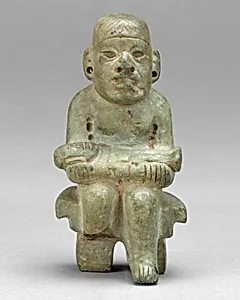
Seated Bench Figure
10th–4th century BCE
Medium
Serpentine
Dimensions
H. 4 7/16 x W. 2 1/4 x D. 2 1/8in. (11.3 x 5.7 x 5.4cm)
Classification
Stone-Sculpture
Culture
Olmec
Department
Arts of Africa, Oceania, and the Americas
Museum
Metropolitan Museum of Art, New York, NY
Credit
The Michael C. Rockefeller Memorial Collection, Bequest of Nelson A. Rockefeller, 1979
Accession Number
1979.206.940
Rights
Public Domain
Tags
Art Historical Context
Behold the *Seated Bench Figure*, a captivating masterpiece crafted by Olmec artists between the 10th and 4th BCE. Carved from sleek serpentine—a green, waxy stone prized in ancient Mesoamerica for its durability and luster—this diminutive sculpture (just 4 7/16 inches tall exemplifies the Olmecs' mastery of miniature stonework. Its compact form, evoking a seated figure perched on a bench-like base, invites close contemplation, blending human and perhaps supernatural traits, as hinted by tags associating it with infants and men. The Olmecs, often hailed as Mesoamerica's "mother culture," flourished in the Gulf Coast region of modern-day Mexico, laying foundations for later civilizations like the Maya and Aztec. These rare serpentine figures, likely used in rituals or as personal talismans, showcase the culture's fascination with transformation—think were-jaguar motifs blending baby-like innocence with predatory power. The artist's technique involved painstaking abrasion and polishing to achieve a smooth, almost lifelike sheen, highlighting rounded forms and crossed legs typical of Olmec style. Housed in The Metropolitan Museum of Art's Arts of Africa, Oceania, and the Americas department, this piece from Nelson A. Rockefeller's collection whispers of ancient beliefs in fertility, ancestry, and the divine. A tiny portal to a lost world, it reminds us how the Olmecs captured profound spiritual energies in stone.