
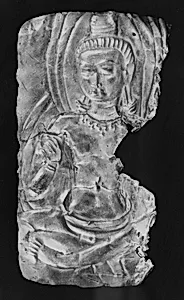
Seated Bodhisattva
Unknown Artist
8th century
Medium
Gold sheet
Dimensions
H. 2 15/16 in. (7.4 cm); W. 1 5/8in. (4.2cm)
Classification
Metalwork
Culture & Period
Thailand · Mon-Dvaravati period
Department
Asian Art
Museum
Metropolitan Museum of Art, New York, NY
Credit
Gift of Dr. and Mrs. Roger Stoll, 1984
Accession Number
1984.494.4
Rights
Public Domain
Tags
Art Historical Context
Behold the delicate *Seated Bodhisattva a masterful 8th-century gold sheet crafted by an unknown artist during Thailand's Mon-Dvaravati period. Measuring just under 3 inches tall and 1⅝ inches wide, thisutive metalwork masterpiece captures a serene Bodhisattva in a meditative pose, embodying compassion and enlightenment. Fashioned from thin gold, it likely employed repoussé techniques—hammering the metal from behind to create raised forms—showcasing the exquisite craftsmanship of ancient Southeast Asian artisans. The Mon-Dvaravati period (roughly 6th–11th centuries) marked a golden age for the Mon people in central Thailand, where Indian-influenced Buddhism flourished through maritime trade. This era produced some of the region's earliest monumental art, but portable pieces like this one served as personal devotional objects, amulets, or adornments for the faithful, highlighting gold's sacred status as a symbol of purity and divinity. In Buddhist tradition, Bodhisattvas vow to aid all beings toward liberation, making this figure a poignant emblem of mercy. Its survival speaks to the enduring cultural reverence for such icons, now preserved at the Metropolitan Museum of Art through the generous 1984 gift of Dr. and Mrs. Roger Stoll. A tiny treasure revealing volumes about faith and artistry.