
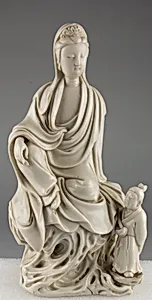
清 德化窯白瓷觀音坐像|Seated bodhisattva Guanyin with an attendant
Unknown Artist
18th century
Medium
Porcelain with ivory glaze (Dehua ware)
Dimensions
H. 9 3/8 in. (23.8 cm); W. 5 in. (12.7 cm); D. 3 1/8 in. (7.9 cm)
Classification
Ceramics
Culture & Period
China · Qing dynasty (1644–1911)
Department
Asian Art
Museum
Metropolitan Museum of Art, New York, NY
Credit
Gift of Mrs. Walter Sachs, 1964
Accession Number
64.166.4
Rights
Public Domain
Tags
Art Historical Context
This exquisite seated figure of Guanyin, the bodhisattva of compassion, accompanied by a small attendant, exemplifies the masterful porcelain craftsmanship of Dehua kilns in Fujian Province, China, during the Qing dynasty's 18 century. Crafted from fine white porcelain with a soft ivory glaze—known as "Blanc de Chine"—this 9 3/8-inch tall sculpture captures Guanyin's serene expression and graceful pose, seated in a meditative lalitasana (royal ease) position, with flowing robes and intricate details like jewelry and a vase symbolizing purity. Dehua ware, renowned for its translucent purity and milky glow, reached its zenith under Qing patronage, blending technical innovation with deep Buddhist devotion. The kilns' kaolin-rich clay allowed for thin, almost translucent walls molded or carved with lifelike precision, making these figures highly prized for altars, exports to Europe, and elite collections. Guanyin’s popularity in Chinese culture reflects her role as a merciful protector, often invoked by devotees for aid in times of suffering. A gift to the Metropolitan Museum of Art from Mrs. Walter Sachs in 1964, this piece invites visitors to appreciate the fusion of artistry and spirituality, where porcelain transcends utility to embody enlightenment.