
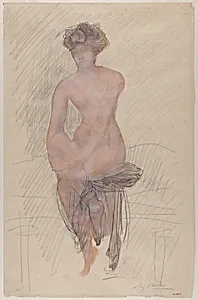
Seated female nude
1900–1910
Medium
Graphite, watercolor, and gouache
Dimensions
19 5/8 x 12 3/4 in. (49.8 x 32.4 cm)
Classification
Drawings
Department
Drawings and Prints
Museum
Metropolitan Museum of Art, New York, NY
Credit
John Stewart Kennedy Fund, 1910
Accession Number
10.66.7
Rights
Public Domain
Tags
Art Historical Context
In the twilight of his illustrious career, Auguste Rodin created *Seated Female Nude* around 1900–1910, a delicate drawing that exemplifies his mastery of the human form. Rendered in graphite, watercolor, andache on paper (19 5/8 x 12 3/4 in.), this work from the Metropolitan Museum of Art's Drawings and Prints department captures a reclining figure in a moment of intimate repose. Acquired through the John Stewart Kennedy Fund 1910, it Rodin's late-period fascination with the female nude, blending sculptural volume with painterly fluidity. Rodin, renowned for monumental bronze sculptures like *The Thinker* and *The Gates of Hell*, produced thousands of drawings as independent studies or preparatory sketches. His style—rooted in realism yet infused with impressionistic light and movement—shines here through loose, expressive lines and subtle color washes that evoke the body's soft contours and inner vitality. Unlike his public bronzes, these intimate works allowed Rodin to explore eroticism and anatomy freely, challenging academic conventions of the fin-de-siècle era. This piece invites visitors to appreciate Rodin's innovative techniques: graphite for precise modeling, watercolor for translucent glow, and gouache for bold highlights. It underscores his enduring influence on modern art, bridging sculpture and drawing while celebrating the timeless beauty of the human figure.
About the Artist
Auguste Rodin · 1840–1917
François Auguste René Rodin (1840-1917) stands as the founder of modern sculpture, transforming the art form from academic tradition into expressive modernism. Born into a working-class Parisian family, Rodin faced early rejection, failing three times to gain admission to the prestigious École des Beaux-Arts. This setback forced him to work as a craftsman for nearly two decades, though his 1875 tr...