
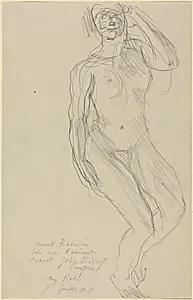
Seated Female Nude Looking Forward
1908
Medium
graphite on folded paper
Dimensions
Overall (folded sh): 31.2 x 20 cm (12 5/16 x 7 7/8 in.) overall (unfolded): 31.2 x 40 cm (12 5/16 x 15 3/4 in.)
Classification
Drawing
Department
CG-E
Museum
National Gallery of Art, Washington, D.C.
Credit
Gift of Mrs. John W. Simpson
Accession Number
1942.5.39
Rights
Public Domain
Art Historical Context
In 1908, near the end of his illustrious career, Auguste Rodin created *Seated Female Nude Looking Forward*, a poignant graphite drawing on folded paper now housed in the National Gallery of Art. This intimate study captures a model in a relaxed, contemplative pose, her direct gaze engaging the viewer with quiet intensity. Measuring 31.2 x 20 cm when folded (expanding to 31.2 x 40 cm unfolded), the paper's portability reflects Rodin's habit of sketching live models in his studio, folding sheets for convenience during rapid sessions. Rodin, a pioneer of modern sculpture celebrated for works like *The Thinker* and *The Kiss*, was equally masterful in drawing. His late-period sketches, like this one, emphasize fluid lines and subtle shading to convey volume and movement, diverging from academic precision toward expressive freedom. Graphite allowed for soft, atmospheric effects, highlighting the nude's form through delicate hatching and smudging—techniques that echo his sculptural sensitivity to light and anatomy. A gift from Mrs. John W. Simpson to the National Gallery's CG-E Department, this drawing exemplifies Rodin's enduring fascination with the human body as both anatomical study and emotional revelation. For visitors, it offers a window into the artist's process, bridging his monumental bronzes with the immediacy of pencil on paper.
About the Artist
Auguste Rodin · 1840–1917
François Auguste René Rodin (1840-1917) stands as the founder of modern sculpture, transforming the art form from academic tradition into expressive modernism. Born into a working-class Parisian family, Rodin faced early rejection, failing three times to gain admission to the prestigious École des Beaux-Arts. This setback forced him to work as a craftsman for nearly two decades, though his 1875 tr...