
Seated Figure
Unknown Artist
6th–7th century
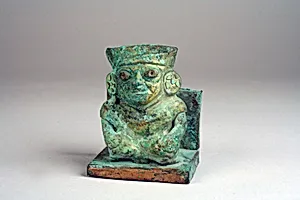
Medium
Gilded copper, stone
Dimensions
H. 2 13/16 x W. 2 3/16 x D. 1 3/4 in. (7.1 x 5.6 x 4.5 cm)
Classification
Metal-Ornaments
Culture
Moche
Department
Arts of Africa, Oceania, and the Americas
Museum
Metropolitan Museum of Art, New York, NY
Credit
The Michael C. Rockefeller Memorial Collection, Bequest of Nelson A. Rockefeller, 1979
Accession Number
1979.206.1274
Rights
Public Domain
Tags
Art Historical Context
This exquisite *Seated Figure*, crafted by an unknown Moche artist between the 6th and 7th centuries, hails from the ancient Moche culture of Peru's northern coast. The Moche, flourishing from around 100 to 800 CE, were master artisans renowned for their sophisticated metalwork and vivid depictions of human forms in art. This small ornament (just 2 13/16 inches tall likely served as personal adornment or a ritual object, reflecting the elite status of its wearer in a society centered on powerful priest-rulers and elaborate ceremonies. Forged from gilded copper with stone elements, the figure showcases the Moche's advanced metallurgical techniques, including depletion gilding—where surface copper was removed to reveal a gold-like sheen—and precise lost-wax casting for intricate details. The compact dimensions (H. 2 13/16 x W. 2 3/16 x D. 1 3/4 in.) highlight its portability, perhaps pinned to clothing or used in shamanic practices. The naturalistic pose of the male figure, with folded legs and attentive posture, evokes authority and contemplation, common in Moche portrayals of warriors, deities, or ancestors. Now part of The Michael C. Rockefeller Memorial Collection at The Metropolitan Museum of Art, this piece offers a window into Moche worldview, where art bridged the earthly and supernatural. Its luminous gilding still gleams, a testament to enduring craftsmanship from a vanished civilization.