
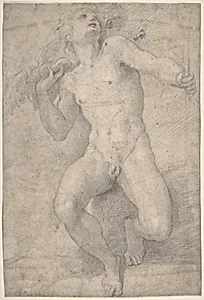
Seated Figure of Mercury
Parmigianino (Girolamo Francesco Maria Mazzola), 1524–26
About this artwork
In the early 1520s, during the shift from High Renaissance to Mannerism in Italy, Parmigianino—born Girolamo Francesco Maria Mazzola (1503–1540)—created this exquisite *Seated Figure of Mercury*. 1524–26, the black chalk drawing captures the Roman god of commerce, travel, and messengers in a relaxed, contemplative nude pose. Measuring just 12 x 8 1/8 inches (30.5 x 20.6 cm), its intimate scale invites close viewing, revealing the artist's masterful command of line and shadow. Parmigianino, a leading Mannerist, was renowned for his elegant, elongated forms and graceful distortions, influenced by Correggio and classical antiquity. This preparatory study exemplifies his drawing prowess: black chalk allows for soft, sfumato-like modeling, building volume through subtle tonal gradations rather than harsh outlines. Likely a modello for a painting or sculpture, it showcases Mannerism's emphasis on idealized anatomy and poetic poise, evoking Mercury's swift, mercurial grace even in repose. Acquired by the Metropolitan Museum of Art in 1997 through generous bequests and gifts, this sheet from the Drawings and Prints department highlights Renaissance draughtsmanship's role in artistic invention. Visitors will appreciate how Parmigianino's fluid strokes breathe life into mythology, bridging ancient gods with 16th-century innovation.