
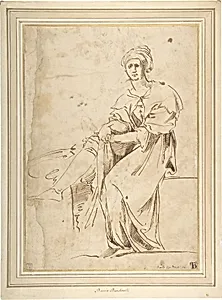
Seated Figure with Cloak and Turban
1493–1560
Medium
Pen and brown ink
Dimensions
14-11/16 x 10-3/8 in. (37.3 x 26.3 cm)
Classification
Drawings
Department
Drawings and Prints
Museum
Metropolitan Museum of Art, New York, NY
Credit
Gift of John Steiner, 1978
Accession Number
1978.22
Rights
Public Domain
Tags
Art Historical Context
Baccio Bandinelli (1493–1560), a leading Florentine sculptor and draftsman of the Mannerist era, produced this expressive pen-and-brown-ink study of a seated woman. Best known for his rivalry with Michelangelo and his monumental marble figures, Bandinelli frequently turned to drawing to explore pose, drapery, and costume before translating ideas into stone. The sheet’s confident, economical lines reveal his sculptural sensibility even on paper, as folds of the heavy cloak are rendered with bold hatching that suggests volume and weight. The turban and flowing mantle evoke the Renaissance fascination with exotic or biblical dress, common in both preparatory studies and independent works on paper. Executed in pen and ink—a medium prized for its immediacy and permanence—this drawing likely served as a quick exploration of form rather than a finished presentation piece. Its generous scale (roughly 37 × 26 cm) allows the figure to command attention while still revealing the spontaneous quality of the artist’s hand. Now part of the Metropolitan Museum’s collection of Drawings and Prints, the work entered the museum in 1978 as a gift of John Steiner. It offers today’s visitors an intimate glimpse of how a major sixteenth-century sculptor thought through costume and posture, bridging the gap between quick sketch and finished monument.
About the Artist
Baccio Bandinelli · 1493–1560
Bandinelli was the son of Michelangelo de'Brandini, a successful Florentine goldsmith. Baccio was a loyal subject of the Medici, even when they were in exile 1494-1513; consequently he was rewarded by receiving commissions after the elections to the papacy of Leo X (Giovanni de' Medici) and Clement VII (Giulio de' Medici), and after Cosimo de' Medici became Grand Duke of Tuscany in 1537. His polit...