
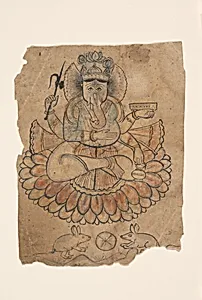
Seated Four-Armed Ganesha
Unknown Artist
ca. 1775
Medium
Ink and opaque watercolor on paper
Dimensions
5 15/16 x 4 1/2 in. (15.1 x 11.4 cm)
Classification
Paintings
Culture
India, Rajasthan, Bundi
Department
Asian Art
Museum
Metropolitan Museum of Art, New York, NY
Credit
Gift of Daniel J. Slott, 1977
Accession Number
1977.440.15
Rights
Public Domain
Tags
Art Historical Context
Behold the *Seated Four-Arm Ganesha*, a 18th-century masterpiece from the Bundi school of Rajasthan, India, created around 1775. This intimate painting, measuring just under 6 by 4.5 inches, captures the beloved Hindu deity Ganesha—elephant-headed remover of obstacles—in a serene seated pose with four arms, likely holding symbolic attributes like his broken tusk or sweet modaka. Accompanying him is his traditional vehicle, the humble rat (Mushika), emphasizing themes of wisdom, prosperity, and humility. Produced during a vibrant era of Rajput patronage, when regional courts flourished amid Mughal influences, such works served as personal devotional aids or illustrations for sacred texts. Crafted in ink and opaque watercolor on paper—a hallmark of Indian miniature painting—the artwork showcases Bundi's signature style: vivid, jewel-toned hues applied in flat, luminous layers for a glowing, almost three-dimensional effect. Fine ink lines delineate intricate details, from Ganesha's ornate jewelry to the rat's alert whiskers, reflecting masterful control and spiritual devotion. Housed in the Metropolitan Museum of Art's Asian Art department (gift of Daniel J. Slott, 1977), this piece highlights Rajasthan's enduring contribution to Hindu iconography, inviting viewers to ponder Ganesha's role as the lord of beginnings in everyday life.